NEW QUESTION 16
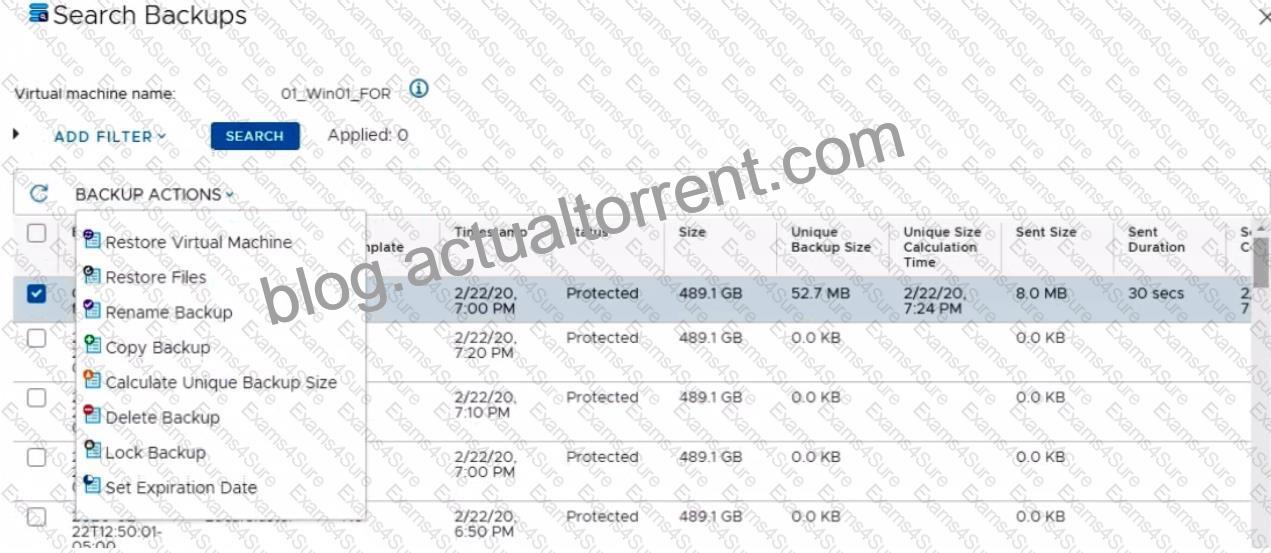
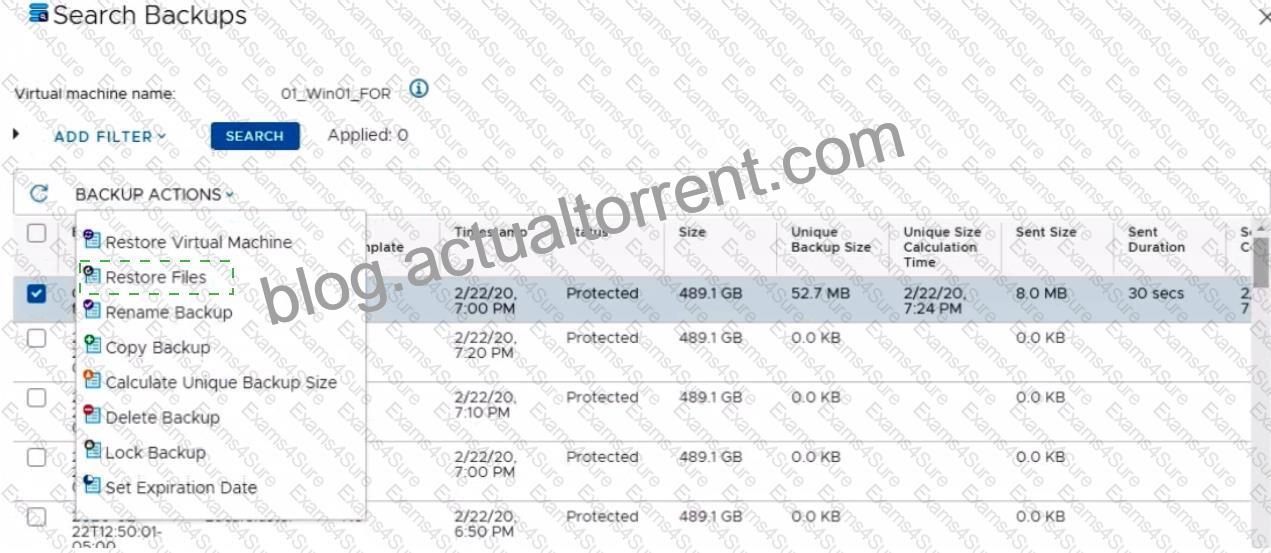
A customer deleted a folder from a virtual machine running Windows. Click the backup option that you should use to restore this folder.
Explanation:
To use this option, you need to select the backup from which you want to restore the files, then click Backup Actions > Restore Files. You will be prompted to enter the following information:
The name of the virtual machine where you want to restore the files
The path of the folder where you want to restore the files
The path of the folder that you want to restore from the backup
The credentials of the virtual machine where you want to restore the files After you enter the required information, click OK to start the restore process3.
HPE SimpliVity Hyperconverged Infrastructure for VMware vSphere 3.7.10 Administration Guide, page 97 HPE SimpliVity Hyperconverged Infrastructure for VMware vSphere 3.7.10 Best Practices Guide, page
20
Restore files from a backup – techhub.hpe.com
NEW QUESTION 22
A customer plans to deploy HPE SimpliVity 380 Gen10 LFF H and HPE SimpliVity 380 Gen10 SFF H nodes.
What should you recommend tor this setup?
HPE SimpliVity 380 Gen10 LFF H and HPE SimpliVity 380 Gen10 SFF H nodes are two types of HPE SimpliVity nodes that differ in their form factor, storage capacity, and performance. LFF stands for large form factor, which means that the node has 3.5-inch hard disk drives (HDDs) and can support up to 40 TB of raw storage capacity. SFF stands for small form factor, which means that the node has
2.5-inch solid state drives (SSDs) and can support up to 23.4 TB of raw storage capacity12.
HPE SimpliVity nodes can be grouped into clusters, which are logical units of compute and storage resources that share the same configuration and policies. HPE SimpliVity clusters can be further grouped into federations, which are collections of clusters that span across different physical locations and provide unified management and data protection34.
For this setup, the recommended design is to put SFF and LFF nodes in separate clusters, but within the same federation. According to the HPE SimpliVity Federation Design and Scaling Guide document, the following reasons support this recommendation:
Mixing SFF and LFF nodes in the same cluster can cause performance and capacity imbalance, as the SFF nodes have faster SSDs and lower storage capacity than the LFF nodes. This can affect the data distribution, deduplication, compression, and backup operations within the cluster .
Separating SFF and LFF nodes into different clusters can allow the customer to optimize the workload placement and performance based on the node characteristics. For example, the customer can use the SFF cluster for high-performance and low-capacity workloads, such as databases or virtual desktops, and use the LFF cluster for low-performance and high-capacity workloads, such as file servers or archives .
Keeping SFF and LFF nodes within the same federation can enable the customer to benefit from the centralized management and data protection features of HPE SimpliVity. The customer can use the same interface to monitor and control the nodes across the clusters, and use the same policies to backup and restore the data across the sites .
References:
1: HPE SimpliVity 380 Gen10 LFF H Node Data sheet 2: HPE SimpliVity 380 Gen10 SFF H Node Data sheet 3: HPE SimpliVity Data Virtualization Platform 4: HPE SimpliVity Federation Design and Scaling Guide : [HPE SimpliVity 380 Gen10 Node Data sheet – PSNow] : [HPE SimpliVity 380 Gen10 Node | HPE Store US] : [HPE SimpliVity Intelligent Workload Optimizer] : [HPE SimpliVity with HPE StoreOnce Reference Architecture] : [HPE SimpliVity Stretched Cluster Guide] : [HPE SimpliVity Remote RapidDR Software Installation and Startup Service]
NEW QUESTION 25
What is the difference between crash consistent and application consistent cloning methods?
The difference between crash consistent and application consistent cloning methods is that the application consistent method ensures that the cloned virtual machine is in a consistent state with respect to the application and database, while the crash consistent method does not guarantee that1. The application consistent method uses the VMware snapshot or the Microsoft Volume Shadow Copy Service (VSS) to quiesce the application and flush the pending I/O operations to the disk before creating the clone, which prevents data corruption or loss2. The crash consistent method does not quiesce the application or flush the pending I/O operations, and creates the clone as if the virtual machine had crashed, which may result in data inconsistency or recovery issues3. The application consistent method is recommended for virtual machines that run database applications, such as SQL Server or Oracle, while the crash consistent method is suitable for virtual machines that run non-database applications, such as web servers or file servers4. The application consistent method is not available only for Linux operating systems (option D), as it also supports Windows Server operating systems that have VMware Tools or VSS installed5. The crash consistent method should not be used only for the virtual machines with Fault Tolerance enabled (option C), as it can be used for any virtual machine that does not require application consistency. Both methods are not the same,and the speed of cloning is not the only difference (option B), as they have different implications for the data integrity and availability of the cloned virtual machine. References:
1: Using HPE SimpliVity Official Certification Study Guide (HPE2-K45), HPE Press, 2019, p. 28.
2: Clone a virtual machine – techhub.hpe.com, HPE, 2021, 3.
3: HPE SimpliVity OmniStack Interoperability Guide 4.2.0, HPE, 2021, p. 8.
4: Using HPE SimpliVity Official Certification Study Guide (HPE2-K45), HPE Press, 2019, p. 29.
5: HPE SimpliVity OmniStack Interoperability Guide 4.2.0, HPE, 2021, p. 9.
[6]: Using HPE SimpliVity Official Certification Study Guide (HPE2-K45), HPE Press, 2019, p. 28.
[7]: Clone a virtual machine – techhub.hpe.com, HPE, 2021, 3.




Be the first to reply